
SMI

Thursday, 22 April 2026

Organised by the Singapore Maritime Institute, Maritime and Port Authority of Singapore, SINTEF Ocean and Norwegian University of Science and Technology, this conference will serve as a key platform for advancing thought leadership, promote knowledge exchange and deepen partnership in maritime research and innovation. SMRC x MTEC/ICMASS
Conference 2026
DISCOVER

Monday, 12 January 2026


Inviting innovative research and technology proposals to advance robotic container fitting handling into a reliable, efficient, and scalable solution for future port operations. If you are advancing robotics, AI, or maritime innovation, we invite you to participate and help shape the next generation of smart port automation. Click the 'DISCOVER' button to learn more.
Research Grant Call DISCOVER

WEDNESDAY, 26 NOVEMBER 2025

The Dispersion Analysis and Simulations for Handling of Future Fuels (DASH) project is a multi-agencies and research institutes effort to develop an integrated suite of tools to accurately characterise, simulate, and manage fuel-related dispersion events. By combining high fidelity, physics-based models, data-driven surrogate models and real time environmental data, DASH can predict how hazardous plumes or spills may disperse—both in the air and in the water. SMI Research
Spotlight Series
DISCOVER

Thursday, 22 May 2025

Chart your journey to shape Singapore’s maritime future! The SMI – MaritimeONE Postgraduate R&D Scholarship supports top local talents to lead innovative research and boost Singapore’s status as a global maritime hub.

Click on the button below to find out more!
SMI – MaritimeONE Postgraduate R&D Scholarship DISCOVER

FRIDAY, 29 NOVEMBER 2024

Watch this episode of the SMI Horizon with Professor Adam Sobey, Programme Director of Data Centric Engineering at The Alan Turing Institute and Professor of Data- Centric Engineering in the Maritime Engineering group at the University of Southampton. Prof Sobey discussed how advancements in data science, machine learning, and artificial intelligence (AI) are transforming engineering. He shared how his work involves shaping innovative solutions for industry challenges, from leveraging vast datasets to realigning skillsets. SMI Horizon DISCOVER

MONDAY, 30 JANUARY 2023

SMI welcomed Professor Low Teck Seng as the new Chairman of the Board on January 2022. Prof Low succeeds Mr Wong Weng Sun, who has stepped down after six years at the helm. Message from
SMI Chairman
DISCOVER
Click here to find out more about SMI - MaritimeONE Postgraduate R&D Scholarship

Events

News

The Latest on LinkedIn

Maritime Centres of Excellence (COEs) and Programme Partners

To establish Singapore as a global maritime knowledge hub through research and technology, build up talent, develop new capabilities, and support breakthrough research applications.

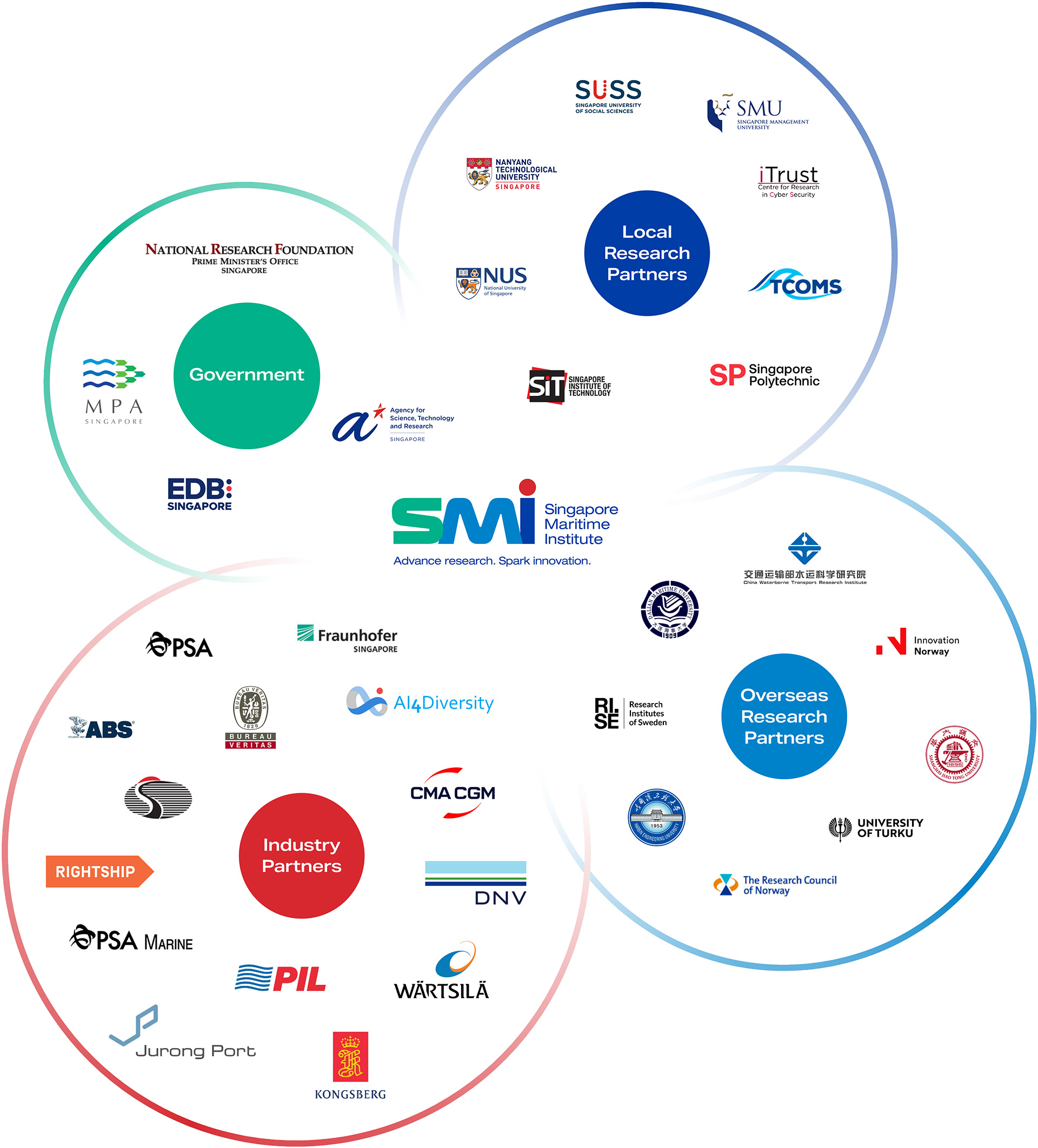
An ecosystem
of local industry partners and global maritime initiatives

To promote greater industry–academia R&D collaborations to be undertaken in Singapore.

Simulation & Modelling (SAM)

Awarded on 17 Oct 2014

In addition to being one of the busiest ports in the world, Singapore has also likewise thrived as one of the leading global maritime capitals that is highly driven by knowledge-based services and expertise. With changing demands and complexity of port and shipping activities, there would be a need for better management of complex port and ship systems.

With global trend drivers, such as shipping market volatility, environmental regulations, and energy cost-efficiency, advanced technological solutions would be required to address these concerns through innovation in port infrastructure and ship design. Hydrodynamics, physical modelling, and mathematical modelling are some of the scientific means towards more cost-effective and environmentally friendly operations. There has also been proposed methodology that focuses more on integrated systems-approach over independent components-approach.

An integrated systems strategy would also drive the need to manage sophisticated engineering and technology through risk-based approach for higher reliability and asset lifecycle management to bring cost benefits. This would enable users to complement both business and technical objectives.

Building upon the above technological trend towards a greater need for advanced complex systems, higher end training would also be required to produce competent manpower with the critical domain knowledge and skillsets. Looking beyond the conventional field of training through simulation, research in the human-machine interface through applied human engineering studies of maritime ergonomics would also be applicable to optimise interaction between people and technology for safety and productivity best practices.

As part of Singapore Maritime Institute’s (SMI) efforts to support the maritime industry in Singapore, a research grant amounting to S$5 million has been allocated to promote research through this thematic R&D programme. The Simulation & Modelling (SAM) R&D Programme aims to support projects involving the research and development of innovative technologies, approaches and ideas towards simulation & modelling for maritime applications.


Programme Themes

  • Risk Management
  • Human Factor Studies
  • Maritime Training & Operation

Asset Integrity & Risk Management (AIM)

Awarded on 02 Nov 2015

In oil & gas E&P, safe and reliable operations are of paramount importance to the industry. Asset integrity should never be compromised and risk management is critical to ensure lives and marine environment are safeguarded.

With enhanced oil recovery techniques, operators are stretching the existing reserves with assets that are reaching their design service life. These aged assets are often susceptible to failures due to mechanical degradations and harsh offshore environment.

Oil exploration has also inevitably moved into deep-sea as shallower oil wells become depleted. The offshore assets are installed in deeper water and are increasingly inaccessible. The associated cost of asset maintenance increases exponentially for deep-water regions resulting in the need for technological innovations in asset integrity & risk management. Integrity assessment and risk management solutions, anticipation of possible failures of systems and emergency response plans in the event of asset failures would be critical.

The offshore assets covered include offshore structures, subsea and down-hole equipment. The key research objectives are:

a) Identification of safety critical elements (SCEs)
The weakest structural components that are most susceptible to external forces, cyclic loadings and harsh environment known as safety critical elements should be identified.

b) Reduction of reliance on manual inspection
The inaccessible assets in deeper water and harsher environment drive the need for remote and autonomous inspection and maintenance which are increasingly reliant on sensor based technologies.

c) Low hardware overheads
Cost is one of the major considerations when sensors and wireless systems are installed. Such overheads include the cost of manufacturing the sensors and systems, power requirement as well installation compatibility with the existing assets.

d) High reliability systems under harsh environment
The increasingly harsh environment at deeper water with strong waves and currents as well as deeper wells with hostile chemicals and high pressure high temperature (HPHT) pose significant technical challenges. Sensors and systems must survive such environment with high reliability.


Programme Themes

  • Software Development
  • Hardware Development & Deployment
  • New Asset Installation
  • System Level Management

Projects awarded (will be updated progressely):

Joint Call for Proposals in Maritime Research between Norway and Singapore (MNS)

Awarded on 21 Mar 2016

Maritime Research between Norway and Singapore (MNS)

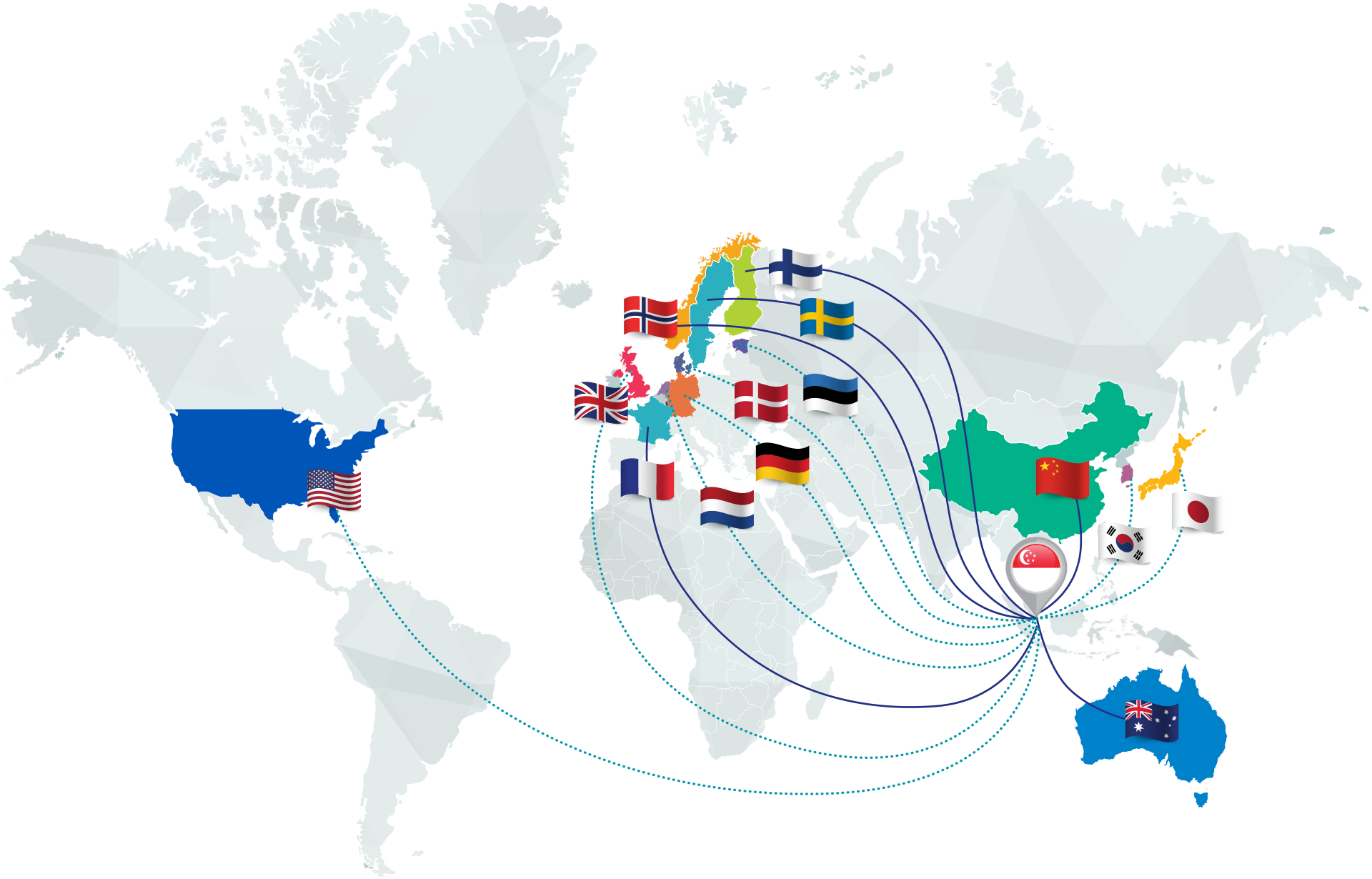
The Maritime and Port Authority of Singapore (“MPA”) and the Research Council of Norway (“RCN”) executed a Memorandum of Understanding on 6th March 2000 (“MOU”) relating to joint co-operation in maritime research, development, education and training. The MOU will be extended for its sixth successive three-year term in 2015.
To further enhance this co-operation, and to facilitate the creation of collaborative projects between the research communities in Singapore and Norway, RCN, MPA and Singapore Maritime Institute (“SMI”) have launched a joint call for bilateral funding of research projects in mutually agreed fields. A total of NOK 15 million is available from RCN for Norwegian partners and up to S$3 million is available from SMI for the Singaporean partners.

Research areas covered

The call is in the field of maritime research. The applications in this call must cover one or more of the following topics:
 
Maritime arctic research
  • Operational decision support systems and logistics solutions
  • Emergency preparedness, prevention & response

Maritime navigation safety

  • e-Navigation
  • Vessel Traffic Management
  • Data analytics on traffic pattern and risk
  • Ship-shore communication
  • Internet of things at sea

Ship operation & safety

  • Simulation & Training
  • Human factors studies
  • Unmanned ships
  • Remote Piloting
  • Control Room Systems
  • Hull structural design

Green shipping

  • Green fuels
  • Energy efficiency
  • Ballast water
  • Hull cleaning
  • Optimizing routing and operation
  • Hull and propeller design
  • Energy saving devices
  • LNG Bunkering in Shipping

Ship-port operations

  • Port optimization
  • Smart ports

Advanced Materials and Manufacturing (Amm)

Awarded on 01 Aug 2016

Oil and gas exploration and production (E&P) has inevitably moved into harsher operating environment. While oil price has slumped to a very low level, industry is focusing on technology developments to lower the cost of E&P. The fundamental sciences such as chemistry, physics and materials have attracted more attention than before in seeking innovative and disruptive technologies to enhance operational efficiency and improve reliability.


Operations in deeper waters with strong waves and currents pose challenges on structural integrity. Operations in Arctic pose a different set of challenges with extreme low temperature. As industry moves into ultra-deep wells with extreme high pressure and high temperature (HPHT), higher reliability is required in meeting the performance specifications to ensure safe and reliable operations. The underpinning material sciences in different operating regimes are the fundamental challenges to the increasingly harsh E&P environment.


Industry is also constantly innovating new materials for offshore applications as well as smart materials which allow more perimeters to be measured for condition monitoring of offshore structures and processes.


SMI through its engagements with the industry and academia has identified the following research thrusts and corresponding research focus areas under the grant call.  The materials covered in this grant call should be used in offshore structures, subsea and down-hole equipment with the following key research objectives:


  1. New materials development and materials enhancement to meet the operating needs under harsher environment while maintaining cost competitiveness
  2. Smart materials developments which allow condition monitoring and improve operational efficiency in the E&P lifecycle
  3. Testing methodologies developments to improve the accuracy of materials assessment and/or allow in-situ assessment to determine real-life residual life and fatigue conditions
  4. Enhancement of materials processability to improve performance and reliability of processed materials and structures


Programme Themes

  • New Materials Development
  • Materials Enhancement
  • Material Testing
  • Material Processing & Manufacturing

Maritime Sustainability (MSA)

Awarded on 04 Jan 2016

Given its location at the crossroad between East and West trade, Singapore is one of the busiest ports in the world for commercial shipping and maritime services. Last year, the Port of Singapore welcomed more than 135,000 vessels and handled a total of 560 million tonnes of cargo. The maritime industry is an important part of Singapore’s economy as it is one of the fastest growing economic sectors, contributing to 7% of Singapore’s GDP.

To address one of the key challenges facing the maritime industry on sustainable shipping, research and development into innovative technologies to transform maritime transportation and port operations will enhance both regulatory compliance and better service offerings by the industry.

SMI through its engagements with the industry and academia has identified the following research areas and possible corresponding research topics under the Maritime Sustainability grant call to support maritime developments and environment protection:


a) Ballast Water Management
Possible Research Topics include Detection and Measuring Equipment / Treatment System, Treatment Technology, and Risk Assessment for Ballast Water Management System.


b) Exhaust Emission Control
Possible Research Topics include Scrubbing / Cleaning Technology, Tools and Systems.


c) Ship Noise & Vibration
Possible Research Topics include Simulation & Modelling, Materials, and Ship Design and Construction.


d) Port Sustainability
Possible Research Topics include Port Air Emission Control Technology, Cleaner Energy for Port, Port Waste-to-Resource Management, and Energy Conservation.

Programme Themes

  • Ballast Water Management
  • Exhaust Emission Control
  • Ship Noise & Vibration
  • Port Sustainability

MPA and SMI Joint Call for Proposals 2020 on Harbour Craft Electrification

Awarded on 01 Oct 2021

The Maritime and Port Authority of Singapore (MPA) and the Singapore Maritime Institute (SMI) have awarded funding to three consortiums led by Keppel FELS Limited, SeaTech Solutions and Sembcorp Marine, and comprising a total of 30 enterprises and research institutions, to research, design, build and operate a fully electric harbourcraft over the next five years. These electrification pilot projects will demonstrate both commercial and technical viability of specific use cases for full electric harbourcraft and will support Singapore’s broader plans to mitigate greenhouse gas (GHG) emissions by the maritime transport sector.


Harbourcraft Electrification Projects

No Consortium lead  Consortium members Project Scope
1 Keppel FELS Limited

Industry

  1. DNV
  2. Eng Hup Shipping

(Vessel owner/operator)

  1. Envision Digital
  2. Surbana Jurong

IHLs/ research institutes

  1. Nanyang Technological University (NTU)
  2. Technology Centre for Offshore and Marine, Singapore
To develop Solid State Transformer based shore charger & electric kit on an existing 30 pax ferry
2 SeaTech Solutions International (S) Pte Ltd

Industry

  1. Batam Fast Ferry Pte Ltd
  2. Bernhard Schulte (Singapore) Holdings Pte Ltd
  3. DM Sea Logistics Pte Ltd
  4. Jurong Port Pte Ltd
  5. Kenoil Marine Services Pte Ltd
  6. Lita Ocean Pte Ltd
  7. Marina Offshore Pte Ltd
  8. Rina Hong Kong Limited Singapore Branch
  9. Sterling PBES Energy Solutions Ltd.
  10. Yinson Production Offshore Pte Ltd

(Vessel owner)

IHLs/ research institutes

  1. Singapore Institute of Technology
  2. Technology Centre for Offshore and Marine, Singapore
To develop a full electric lighter craft[i]
3 Sembcorp Marine Integrated Yard Pte Ltd

Industry

  1. ABB Pte Ltd
  2. Durapower Holdings Pte Ltd
  3. Jurong Marine Services Pte Ltd
  4. OPL Services Pte Ltd
  5. Rolls-Royce Singapore Pte Ltd
  6. SP One Pte Ltd
  7. Tian San Shipping Pte Ltd

(Vessel Owner/ operator)

  1. York Launch Pte Ltd

IHLs/ research institutes

  1. A-STAR Institute of High-Performance Computing
  2. Nanyang Technological University
  3. National University of Singapore
  4. Singapore Institute of Technology
To develop and build a full electric ferry for 200 persons for a specific route
[i] A lighter craft is a vessel used for the carriage of dry or packaged cargoes.